
 Marketing


Inflation shifts consumers’ shopping behaviors and the way marketers manage their brands. Learn the latest consumer behavior patterns, challenges for brands, and ways how to act.
Continuously high inflation rates in Lithuania increased price sensitivity and affected overall consumption. People are more conscious of how to spend their money and brand owners are more aware about what type of communication campaigns to launch as a response – sales activations or brand-building. The media landscape indicates that brand-building activities are now overshadowed by sales activations, which gives an instant result in sales. But is it the only choice in current times? This business insight identifies what brand-building mistakes to avoid in challenging times.
Consumers got used to inflation and adjust to economic recession
- Consumers are statistically less worried about their finances than a year ago;
- People are more willing to consider high-quality, premium products;
- Consumers tend postpone a purchase of a preferred high-quality product than to choose a cheaper alternative.
Sale activation is a promising communication topic, but only for a short period of time
- Although price promotion has an immediate effect on sales, it doesn’t last.
- Even in times of inflation brand brand-building cannot be ignored – a 60:40 rule;
- Short-term goals should not overshadow long-term brand-building
A recent quantitative survey in Lithuania (Norstat, 2023) identified a decrease in financial stability-related concerns (from 81% in 2022 to 70% in 2023). While inflation remains the main cause of anxiety people got used to it and feel more willing to buy high-quality and price premium products. The survey indicates people are less likely to reduce their consumption than a year ago, especially in categories like smart devices and electronics (53% of the population in 2022 and 34% in 2023), groceries (42% in 2022 and 18% in 2023) or sports equipment (56% in 2022 and 39% in 2023).
Despite the willingness to pay price premiums for high-quality products, consumers still pay attention to discounts like a year ago (71% now and 73 % a year ago). It leads to the conclusion that consumers are now less likely to buy product for its regular price. But it is only true for brands and products people have already tried and were satisfied. Consumers are not so easily attracted (or should we say distracted) by the promotions and discounts of other than their preferred brand. This fact suggests, sales activation work as a retention, not an acquisition strategy (Sharp, 2018).
While sales activations have their limitations, they remain very popular form of communication, especially in times of economic tensions. Even the leader brands which are never cheap have the practice of regular sales activations. Sales activation generates evident spikes in sales but they rarely deliver extra profit or last any longer than the promotion itself (Sharp, 2018).
Another advertising genre is meant for fulfilling the brand with required associations with no focus on the price. Differently than a sales activation, brand-building (or so-called “image communication”) activities’ effect on sales is not sudden but rather cumulative (figure 1). It takes time to establish, but it is worth it – brand-building campaigns improve long-term sales growth and equip brands with pricing power (Wood, 2019).
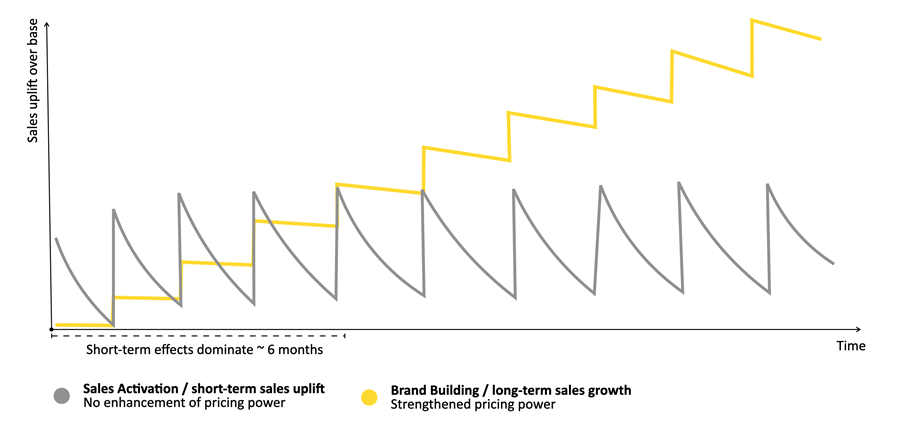
The proven rule of balancing the budget for brand-building and sales activation is 60:40, where 60% of the budget goes to brand-building and 40% to sales activation (Binet & Field, 2013). Only then long-term goals can be achieved. And when it might seem as a counterintuitive, this rule is also true in times of economic turbulences.
Businesses should pay attention to the fact, that even in light of inflation consumers are not willing to make compromises for quality or easily switch their favorite brand to the alternative. In a near future people will be less spontaneous with their purchase decisions and think twice before buying. In the meantime, brands will aggressively fight for clients’ attention and money. Brands with stronger image and higher loyalty will win.
Companies should not neglect their brands and substitute brand-building activities with sales activations. Despite the lingering financial concerns, consumers prefer brands they know, care and like, rather than those shouting loudest about the lowest prices.
References
- Sharp, B. (2018). How brands grow. What marketers don’t know. Oxford University Press.
- Binet, L., Field, P. (2013). The long and short of it. IPA.
- Wood, O. (2019). Lemon. How the advertising brain turned sour. IPA.
- Havas Group Lithuania (2023). Quantitative population behaviour study. Norstat.